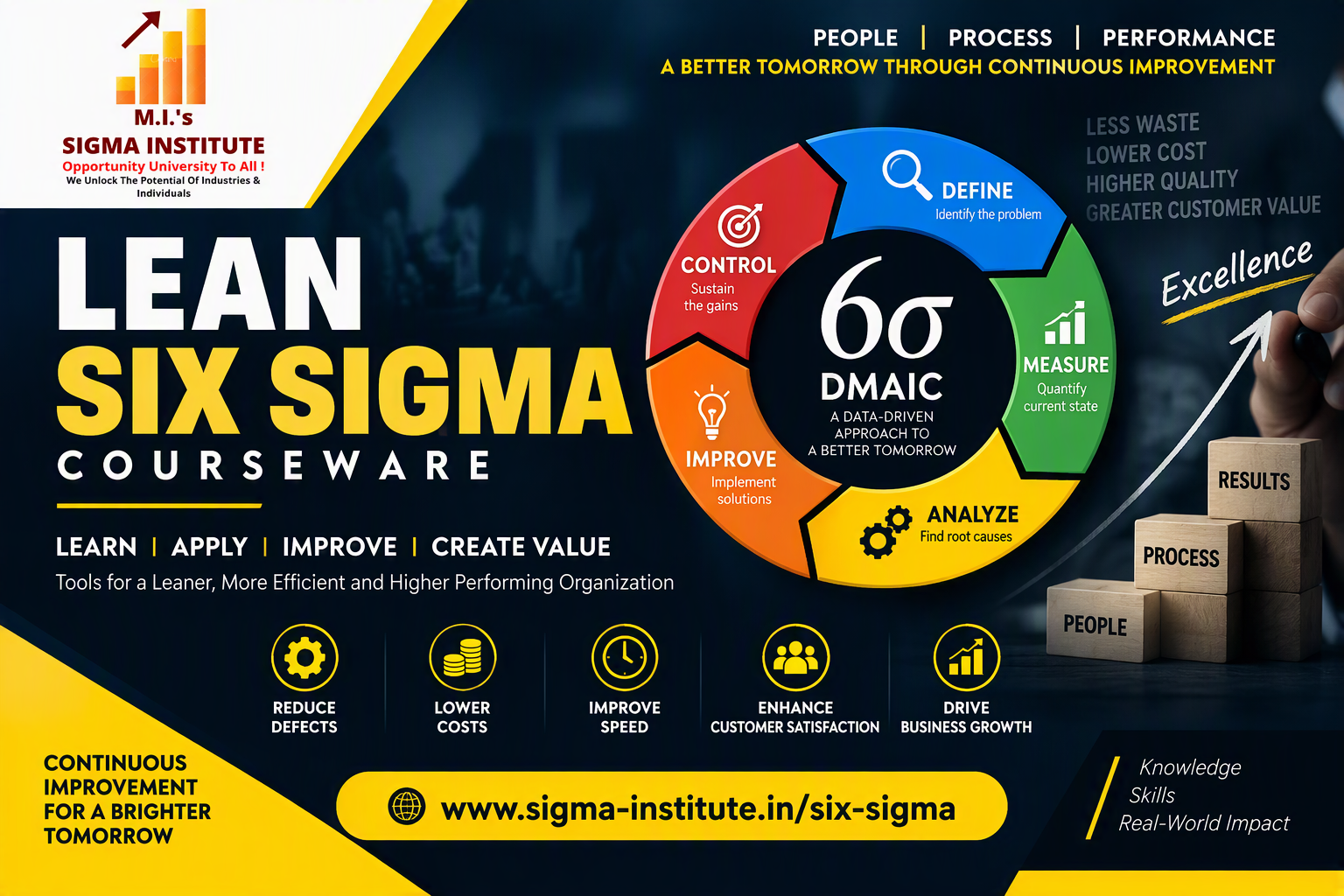
Lean concepts & Six sigma concepts evolved seperately.In today’s competitive business environment, organizations are constantly looking for ways to improve efficiency, reduce waste, and enhance customer satisfaction. Lean Six Sigma is one of the most effective methodologies used worldwide to achieve these goals.
What Is Lean Six Sigma?
Lean Six Sigma is a process improvement methodology that combines two powerful approaches:
- Lean focuses on eliminating waste and improving workflow efficiency.
- Six Sigma focuses on reducing defects and process variation through data-driven decision-making.
Together, they help organizations deliver higher quality products and services while reducing costs and improving customer satisfaction.
Understanding Lean
Lean originated from the Toyota Production System and aims to maximize customer value while minimizing waste.
Common types of waste identified in Lean include:
- Overproduction
- Waiting
- Transportation
- Overprocessing
- Inventory
- Motion
- Defects
- Underutilized Talent
By removing these wastes, organizations can improve productivity and reduce operational costs.
Understanding Six Sigma
Six Sigma is a structured approach that uses statistical methods to identify and eliminate process defects.
The primary goal of Six Sigma is to achieve nearly perfect process performance by reducing errors and variations.
Six Sigma projects often follow the DMAIC methodology:
D – Define
Identify the problem, goals, and customer requirements.
M – Measure
Collect data and establish the current performance level.
A – Analyze
Determine the root causes of the problem.
I – Improve
Develop and implement solutions.
C – Control
Monitor the process to sustain improvements.
Benefits of Lean Six Sigma
Organizations adopting Lean Six Sigma can experience:
- Improved product and service quality
- Reduced operational costs
- Faster process completion
- Increased customer satisfaction
- Better employee engagement
- Data-driven decision-making
- Higher profitability
Real-World Applications
Lean Six Sigma is used in various industries, including:
Manufacturing
Reducing production defects and downtime.
Healthcare
Improving patient care and reducing waiting times.
Banking and Finance
Streamlining approvals and reducing processing errors.
Information Technology
Enhancing software quality and service delivery.
Education
Improving administrative processes and student services.
Lean Six Sigma Certification Levels
Professionals can pursue different certification levels based on their experience and career goals:
White Belt
Introduction to Lean Six Sigma concepts.
Yellow Belt
Supports improvement projects and understands basic tools.
Green Belt
Leads small to medium-scale projects.
Black Belt
Manages complex projects and mentors Green Belts.
Master Black Belt
Provides strategic guidance and organizational leadership.
Who Should Learn Lean Six Sigma?
Lean Six Sigma is valuable for:
- Students and fresh graduates
- Quality professionals
- Process improvement specialists
- Project managers
- Operations managers
- Manufacturing engineers
- Healthcare professionals
- Business analysts
Conclusion
Lean Six Sigma is more than a certification; it is a proven methodology for solving problems, reducing waste, improving quality, and driving continuous improvement. Whether you are a student looking to enhance your resume or a professional aiming for career growth, learning Lean Six Sigma can provide valuable skills that are in demand across industries.
By understanding Lean principles and Six Sigma techniques, individuals and organizations can achieve sustainable success and operational excellence.
Contact Us


OR
Get in touch to find your solutions:
Team Sigma Institute
sk@sigma-institute.in